
By Azman Zakaria
Photos by Mohd Hasrul Hamdan
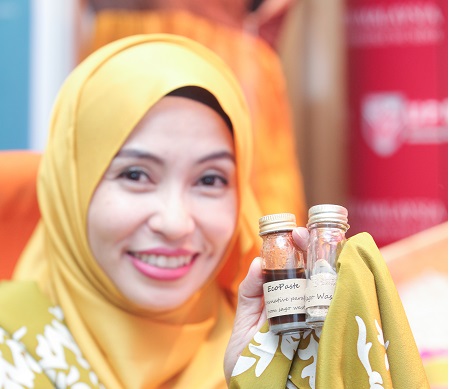
SERDANG, Oct 6 – For many years, sago waste is simply disposed of after starch is extracted, without much effort is made to turn it into products that can be beneficial to humans.
Sago waste dumping – In Sarawak alone, about 60 tonnes of sago effluents are thrown away every day, leading to a large proportion of environmental issues. A large amount of waste dissipates into the rivers because of the assumption that it is ideal a meal for the fish when in reality, it is not.
Such an action has led to river pollution where the water turns sour due to high sugar content and proliferation of bacteria in sago waste. This, eventually, leads to rivers turning acidic, thus threatening the lives of animals and plants surrounding the areas.
There are factories that have resorted to burning the effluents after knowing that the method is a definite no-no, but burning the waste can lead to air pollution.
These scenarios have inspired Head of Industrial Design Department , Faculty of Design and Architecture UPM, Assoc Prof. Dr. Nazlina Shaari to come up with beneficial products from sago waste.
“I just want to turn it to good use. Tonnes of sago waste are dumped daily but there is no solution to address the problem.
“I want to help the community…give added value to sago operators and batik owners and do something for the environment,” she said.
The project to turn sago waste to replace batik waxes and prints on textiles commenced in 2012 using an allocation of RM90,000 through the Prototype Research Grant Scheme (PRGS).
The project was carried out together with researchers from Universiti Malaysia Sarawak (UNIMAS).
“After many rounds of experiments, we finally arrived at a successful formula at the end of last year. We searched for as many formulas as possible before this particular formula which is accurate and able to produce satisfactory results where batik patterns did not expand and the colours did not just fade away,” she said.
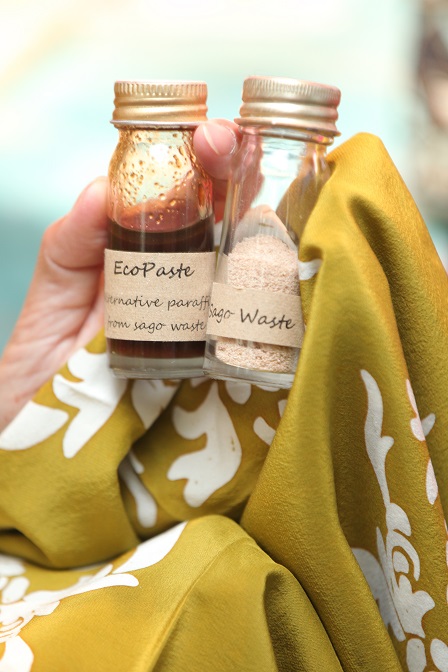
This new innovation in batik printing industry is given the name EcoPaste as it is safer and environmental-friendly and will replace paraffin waxes for batik designing and printing.
EcoPaste innovation entails a thickening agent using natural biodegradable materials developed from sago waste. Sago waste and water effluents are formulated into the form of powder for easier mixing and keeping compared to the existing printing products.
Dr. Nazlina also said the sago formula was derived at from a dyeing process using a myriad of natural substances such as turmeric, pericarp, rambutan skin and mango leaves, depending on the shades they want to produce.
“A myriad of colour tones can be produced from each of this environmental-friendly substance,” she said.
Dr. Nazlina added that the EcoPaste product could be used on linen, silk and cotton using batik blocks and silk screens.
“A plus-point for this formula as compared to the present techniques being used is that it can act as a thickening substance for batik prints or as a resis in the making of intricate batik motifs and blocs, and can be re-used many times either in cool or warm mode by just adding warm water,” she said.
This product has won many awards, including a Gold award and a Special Prize Award of the Biotechnology Innovation of the Year at Bioinnovation Awards 2015, Special Prize Award by the Korean Society of Design Science at the International Spring Invitational Exhibition Seoul, Korea 2014, and Double Gold Award at British Invention Show 2012.
Presently, she said, paraffin waxes and imported synthetic thickeners were used extensively in batik printing and designing in Malaysia.
These substances contained toxins and chemical fumes from paraffin waxes could pose health hazards such as irritation to the eyes, skin, lungs and discomfort to the respiratory system in the long run.
In addition, she said, during the removing of paraffin wax process, a high level of toxic will be discharged into the streams and rivers, thus affecting the quality of water and the environment. – UPM.